
In short
- Outdoor fabric is sold by fibre name, but colour life comes from the dye route: solution-dyed acrylic carries pigment inside the filament, piece-dyed polyester near the surface.
- Lightfastness is reported on the ISO 105-B02 blue wool scale of 1 to 8, not in summers, so a years-of-fade claim needs its method, hours and irradiance stated.
- A cushion fails at the seam, the zip and the foam: closed foam under a stitched waterproof cover keeps the water that enters through a needle hole.
Outdoor fabric is a textile specified for permanent exposure to daylight, rain and either chlorine or salt air, normally as a cushion cover, a sling seat or a parasol canopy; the fibre and the dye route together decide how it ages.
The swatch carries a fibre name rather than a performance figure. Acrylic can mean a yarn with pigment through the filament or a yarn with colour sitting on the surface, and the tag rarely says which. The cushion it becomes is judged by what the foam does after rain.
01Solution dye is a fact about the yarn, not the fabric
Solution dyeing, also called dope dyeing, puts pigment into the polymer before the fibre is formed, so colour runs through the filament rather than sitting on it. Abrasion removes material without removing the colour.
That answers one question: will the face survive light and wear? It says nothing about ultraviolet resistance in the polymer, the trim, or water.
Olefin, the name usually used for polypropylene, is almost always mass-pigmented, because the fibre has no dye sites for a conventional dyebath. It can be solution-dyed and still fade, because the pigment survives inside a polymer that is breaking down.
| Route | Where the colour sits | What fades first | Question to ask |
|---|---|---|---|
| Solution (dope) dyeing | Inside the filament, before extrusion | The polymer, if not UV-stabilised | Which fibre, and which lightfastness result? |
| Yarn dyeing | Through the yarn before weaving | The finest yarn in the weave | Does the pattern repeat across dye lots? |
| Piece dyeing | On the woven cloth, often last | The face, at the first abrasion | Is it piece-dyed, and what is the rubbing result? |
The route describes the yarn, not the fabric; weave and weight in g/m² still decide how a cover behaves.
Decision rule: ask which fibre it is and what was tested on it before any price is compared. A supplier who answers both has a product file; one who answers only the first has a label.
02Lightfastness is a test result, not a number of summers
Colour fastness to light is measured by exposing the fabric beside blue wool references and reporting which faded at the same rate, on a scale of 1 to 8; the result is a comparison under stated conditions, not a lifespan.
ISO 105-B02 sets out the exposure, and the method matters: a dry specimen behind glass and a wet specimen outdoors are different tests. When a supplier quotes 6, ask which method and for how many hours.
Accelerated weathering is the other half. Under a xenon-arc lamp to ISO 4892-2 the specimen takes a dose that is irradiance multiplied by time: 500 hours at one irradiance is not 500 hours at another. Ask for W/m² at 340 nm, the hours, and whether the cycle included spray.
That is the honest answer to a years claim. A ten-year fade promise is an extrapolation using an assumed annual dose of sunlight, which may hold on a shaded temperate terrace and fail on a roof in the Gulf.
Decision rule: for a fixed cushion in full sun, accept a colour claim only with the ISO 105-B02 method, the blue wool result and the exposure hours. For a washable cover, add a washing and a rubbing result on the grey scale of 1 to 5.
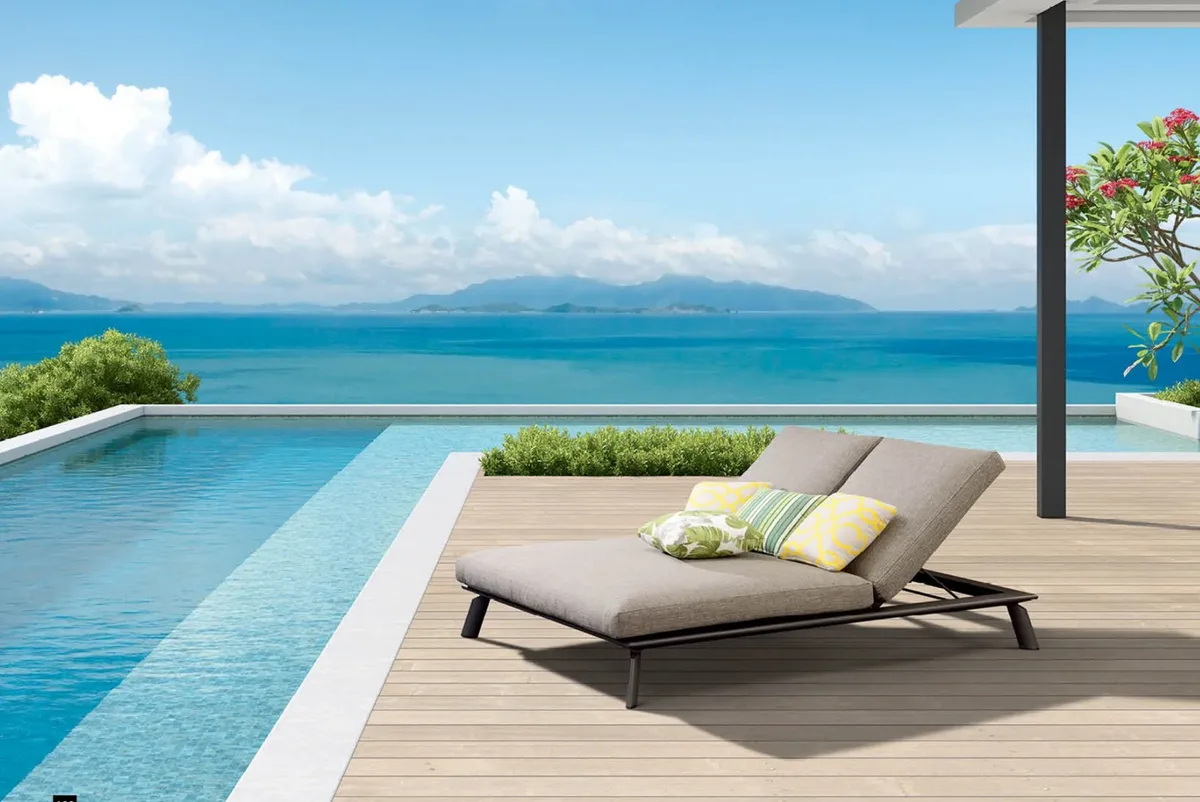
Catalogue reference: outdoor furniture and terrace seating — models, dimensions and finishes for the directions discussed above.
03The trim fades first, and the eye reads the piece as old
The cover is usually the most colour-stable part of a cushion. Seam thread, binding tape, zip tape, piping cord and label are separate purchases, usually polyester, and rarely dyed to the cover's reference.
The result is a fade gradient rather than a fade: the field holds, the piping pales, the thread greys, and by the third season the piece reads as old. On navy the shift is obvious; on a mid-tone it is nearly invisible.
Stitch density belongs to the same detail. A seam is both a structural line and a water path: 4 stitches per 25 mm against 8 roughly doubles the thread and the needle holes.
Decision rule: name the trim in the same clause as the cover — one colour reference, the same dye route where possible, piping cut from the cover fabric rather than bought as matching cord. Where the trim cannot be specified, treat the colour choice as the risk control and pick one whose fade is least visible.
04Acrylic, olefin and polyester fail in different weather
Solution-dyed acrylic holds colour under ultraviolet better than olefin, olefin takes up less water and resists rot better than the other two, and polyester is the stronger fibre that needs a UV stabiliser outdoors.
| Fibre | Colour route | Ultraviolet | Water | Abrasion |
|---|---|---|---|---|
| Acrylic | Usually solution-dyed | The most colour-stable of the three | Takes up some water; dries without rot | Moderate; pills at a rubbed edge |
| Olefin (polypropylene) | Mass-pigmented, because it cannot be dyed conventionally | The polymer degrades while the pigment survives | Very low uptake; floats | Good, but heat-sensitive |
| Polyester | Piece-dyed or solution-dyed | Needs a UV stabiliser; a piece-dyed face shifts first | Low uptake; dries quickly | The strongest of the three |
Fibre behaviour only. Weave, weight and finish change every column.
PVC-coated polyester answers a different brief. It is waterproof and wipeable, which suits a contract seat by a pool bar, and it does not breathe, which is wrong for a cushion that must dry from inside.
Chlorine and salt are separate exposures. A poolside cover is rinsed or it is not, and the difference shows at the seam and the zip before the face. Colour fastness to chlorinated water has its own test, ISO 105-E03.
Decision rule: choose by exposure, then by test — a fixed cushion in full sun takes acrylic; a sling that must stay taut when wet takes olefin; a wipe-down seat under a canopy takes PVC-coated polyester; a washable cover takes polyester with a UV stabiliser.
05The cushion that holds water
An outdoor cushion holds water in three places, the cover face, the seam and the foam, and the foam is the reservoir; the cover only decides how fast it fills and whether it can empty.
The arithmetic is worth doing once. A 600 × 600 × 120 mm seat block encloses 0.0432 m³, about 43 litres. Water weighs roughly 1,000 kg per cubic metre, so if a tenth of that volume stays filled the cushion carries about 4.3 kg of water, low against the frame.
Closed-cell foam is buoyancy foam, the family used in life jackets and pool floats, and it does not shed water that gets past the cover. Open-cell foam holds water but releases it through airflow; reticulated foam releases it faster.
| Construction | Cover and seam | Foam | After rain |
|---|---|---|---|
| Sealed | Welded or taped seams, no stitch through the barrier, waterproof zip | Closed-cell | Runs off; a puncture or worn seam traps water |
| Drainable | Stitched seam set low, mesh or vented underside, drainage gusset | Open-cell or reticulated | Fills, then drains and dries through airflow |
| The middle | Water-resistant face, stitched, with a waterproof liner behind it | Closed-cell block | Fills through the stitch holes, cannot empty, smells |
A construction is a package. Changing one line, such as the foam, changes what the other two can do.
The middle row is the one that fails, and it is the one most often quoted as waterproof. Water crosses the face slowly, enters at the stitch holes and the zip, and meets a liner that will not let it out.
Decision rule: choose sealed or drainable and write it into the order. Sealed means welded or taped seams, no stitch through the barrier and closed-cell foam. Drainable means open-cell foam, a mesh underside, a gusset and no liner. A stitched water-resistant face over a closed block is the design to reject.
06Foam, seam and zip: approve them on a sample, not a photo
The three details that decide whether a cushion dries are the foam's cell structure, the seam type and the zip, and all three can be checked on one made-up sample.
Foam is specified by type, density in kg/m³ and compression set, not by a trade word. A dry-fast claim without a density describes the surface, not the behaviour. Ask whether it is open-cell and what it should do after a night of rain.
Seams are stitched or welded. A stitched seam is a line of holes; a welded or taped seam is a barrier, and a stitched top seam needs a drainage path underneath.
The zip is the largest opening in the cover. A zip on the top edge is a funnel; a covered zip with a flap and a gutter sheds water from the teeth. Near salt, specify a nylon coil with a plastic slider, or name the metal and its grade.
- Tip a cup of water along the top seam and watch the underside; where it appears first is the water path.
- Stand the cushion on one edge for an hour and see whether water leaves at the gusset, mesh or zip.
- Press the foam flat and time its recovery; a slow recovery is a foam that will stay compressed.
Decision rule: approve only the sample you tested, keep it, and write its construction — foam type, density, seam and zip — into the purchase order. A photograph is not a sample and cannot be approved as one.
07Contract, fire and what the warranty leaves out
A fabric that passes a lightfastness test can still fail the piece it is sewn into: the furniture standards test the seat, the fire standard tests the combination, and the warranty usually excludes the trim and the foam.
EN 581 covers outdoor furniture in three parts, for general safety, domestic use and contract or public use, with EN 1022 for stability and EN 1728 for strength; contract seating has its own standard in EN 16139. None tests the fabric in isolation.
Fire is tested as a combination. EN 1021-1 uses a smouldering cigarette and EN 1021-2 a match flame; contract projects often ask for BS 5852 crib 5, and the United States uses CAL 117. A certificate for the fabric alone does not describe your cushion. A heated seat adds a separate claim under IEC 60529, where IP65 is dust-tight and water-jet resistant and IP67 allows temporary immersion.
The frame is a separate clause. Powder-coated aluminium resists corrosion but chips at cut edges, 304 stainless is common, and 316 is specified for coastal salt. On a balcony, wind uplift under EN 1991-1-4 acts on the cushion too, so a soaked cushion becomes a structural question.
On warranty, ask what is excluded before the order. Fade, mould, trim and foam are the usual exclusions; the problem is the warranty that stays silent until the first claim.
Decision rule: require fire and strength evidence for the piece being bought, with the frame and foam named on it, and read the exclusions for fade, mould, trim and foam before the order. If the care regime will not be followed in service, specify the construction that survives neglect.
What your RFQ should state
- Fibre and dye route named separately: solution-dyed acrylic, mass-pigmented olefin, or polyester with a UV stabiliser.
- Lightfastness to ISO 105-B02 with the method, the blue wool result from 1 to 8, the hours and the irradiance in W/m² at 340 nm.
- Trim named with the cover: seam thread, binding, zip tape and piping at one colour reference.
- Cover weight in g/m² and width in cm with the weave, plus a tensile result in N per 50 mm strip for a sling.
- Cushion construction declared sealed (welded seams, no stitch through the barrier) or drainable (open-cell foam, mesh underside, drainage path).
- Foam described by type, density in kg/m³ and compression set, not by the word dry-fast.
- Zip type, tape, slider material and position, with the flap or gutter drawn, plus stitch density per 25 mm.
- Fire result for the cover-and-foam combination to EN 1021-1 and EN 1021-2, or the standard the project names.
Where this guidance stops
- This article describes fibres, constructions and test methods, not named products. Two solution-dyed acrylics can share a dye route and differ in polymer, weave and finish.
- A swatch cannot show how a trim will fade or how a seam will pass water; that needs a made-up cushion and a wet test.
- Colour is judged against a master under a stated light source, and a photograph, a screen and a showroom lamp will disagree; the criterion has to be a measured ΔE tolerance in writing.
- Fire, stability and strength results belong to the piece tested, not to the fabric roll; a certificate does not transfer between frames, foams or covers.
- Foshan Supply coordinates sourcing, sampling and inspection. We do not test fabrics, issue certificates or offer a universal warranty; the supplier's declared data and the agreed inspection scope govern.
Questions buyers ask
Is solution-dyed acrylic better than olefin for outdoor cushions?
For colour under sun, yes: solution-dyed acrylic is the more UV-stable of the two, which is where a cushion in full sun usually lands. Olefin takes up less water and suits a sling that must stay taut when wet, but the fibre itself degrades.
How long will outdoor fabric last before it fades?
No test reports a number of years. Lightfastness is a blue wool result from 1 to 8 under ISO 105-B02, and a years figure is an extrapolation using an assumed annual dose of sunlight. Ask for the method, the hours and the irradiance in W/m².
Why does my outdoor cushion smell musty after rain?
Water reached the foam and could not leave. A water-resistant cover stitched over a closed foam block lets water in at the seam and the zip, and the foam holds it. Open-cell foam with a drainage path, or a sealed cover, prevents it.
Can outdoor cushion covers be machine washed?
Some can, and the care label should give a temperature and a drying instruction. Washing takes colour and size out of a fabric, so ask for a washing result and a shrinkage figure on the fabric supplied. Line dry rather than tumble.
What is the blue wool scale, and what number should I ask for?
It is the reference scale used in ISO 105-B02: eight blue wool samples that fade at known rates, so a fabric's result is the number of the reference that faded with it. The result compares only within one method, so ask for the number, method and hours together.
Does a waterproof cushion cover keep the foam dry?
Only if it is sealed rather than stitched. A waterproof face with a stitched seam and a waterproof liner behind it lets water in through the needle holes and traps it against the foam, which is worse than a breathable cover. Weld or tape the seams.
Should outdoor cushions be brought in over winter?
Where the frame stays out, bring the cushions in or store them dry and off the floor; a cushion left on a wet seat deck for a season is a mould test. In wind, an unsecured cushion is also a wind load.
Sources
- EN 581-1, EN 581-2 and EN 581-3 — Outdoor furniture: safety, strength and durability for domestic, contract and public use — European Committee for Standardization
- EN 16139 — Furniture: strength, durability and safety of contract seating — European Committee for Standardization
- EN 1991-1-4 — Eurocode 1: Actions on structures, Part 1-4: General actions, wind actions — European Committee for Standardization
- ISO 105-B02 — Textiles: tests for colour fastness, colour fastness to artificial light (xenon arc fading lamp test) — International Organization for Standardization
- ISO 105-A02 — Textiles: tests for colour fastness, grey scale for assessing change in colour — International Organization for Standardization
- ISO 105-E03 — Textiles: tests for colour fastness, colour fastness to chlorinated water — International Organization for Standardization
- ISO 4892-2 — Plastics: methods of exposure to laboratory light sources, xenon-arc lamps — International Organization for Standardization
- IEC 60529 — Degrees of protection provided by enclosures (IP code) — International Electrotechnical Commission
Pages related to this guide
How this guide was checked
- Written from the public catalogue, the standards and regulator pages listed under Sources, and the process records described on the services page.
- Catalogue references and model details were checked on 2026-11-05; 8 primary sources are linked above.
- No supplier paid for placement. No price on this page is an offer; ranges are planning references and must be confirmed in a quotation.
How these guides are researched and reviewed · Corrections policy