
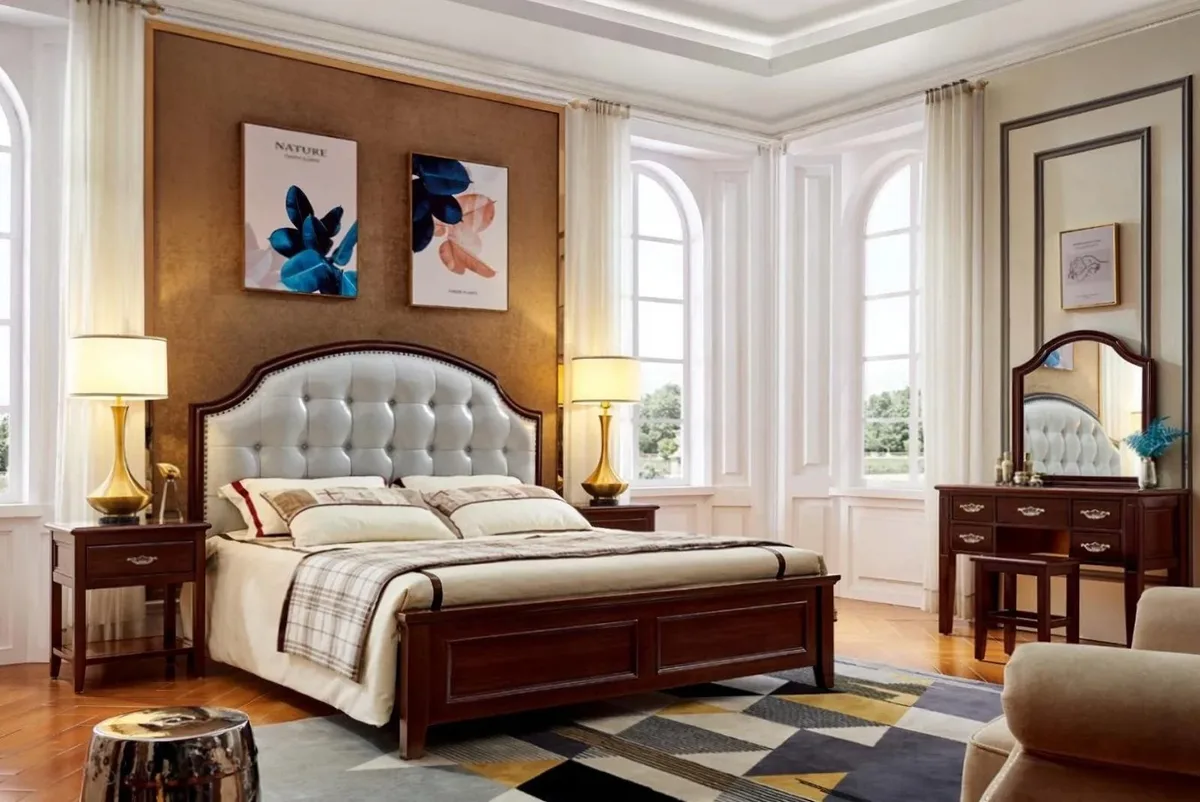
In short
- Hotel FF&E sourcing is the purchase and coordination of furniture, fixtures and equipment against a room-by-room schedule, from drawing approval to the installed room.
- A schedule states item number, room type, quantity, dimensions, finish, fabric, drawing reference, supplier, status, location and date. Without those fields it is a mood board.
- Contract grade is proved by test reports, not by weight: a BIFMA standard for structure, Martindale or Wyzenbeek for abrasion, and TB 117-2013 or BS 5852 for flammability.
Hotel FF&E sourcing is the work of turning a room-by-room furniture, fixtures and equipment schedule into approved, tested and labelled goods that reach the right floor on the day the crew needs them. FF&E is distinct from OS&E — operating supplies and equipment — and that split decides who buys what and which container a carton travels in.
Most hotel furniture is not difficult to make. It is difficult to make identical, on time, and to a drawing four parties approved. The failures that reach the buyer are rarely craft: a fabric that arrived short, a finish approved from a photograph, a carton labelled by purchase order instead of by room. All three are schedule failures, visible months before the ship sails.
01A schedule is a purchasing document, not a mood board
A usable FF&E schedule answers, for every line, what is being bought, how many, to which drawing, in which finish, from whom, and where and when it must arrive. A row without a drawing reference or a status is a hope.
Hotels repeat a room with variants: a king, a twin, a suite and an accessible room can share a furniture family and still need different clearances. One row per variant stops the factory guessing.
| Field | What it states | What it controls |
|---|---|---|
| Item number | One unique code per line | Factory label, packing list |
| Room type | King, twin, suite, accessible | Variant and clearances |
| Quantity | Units required, plus spares | Cutting list, carton count |
| Dimensions | Width × depth × height in mm | Layout, lift access, door swing |
| Finish | Species, veneer, lacquer, sheen | Sample approval, batch match |
| Fabric / COM | Supplier, pattern, colourway, metres | Fabric buyer and risk |
| Drawing reference | Number and revision | What is being built |
| Supplier | Factory or trader, named contact | Inspection and warranty |
| Status | Specified, approved, in production | What may be released |
| Location | Building, floor, room number | Loading order, labelling |
| Installation date | Date the room must be complete | Production and freight mode |
Adapt the columns to the project. The test is whether a factory could build from the row without asking a question.
Our A603 entry lists a bed at 2,160 × 1,920 × 1,550 mm and a bedside cabinet at 560 × 460 × 660 mm. That checks a layout, not a production release: the row still needs finish, fabric and drawing revision.
02FF&E is not OS&E, and the split decides who buys what
FF&E covers what is fixed to the building or too large to carry away: beds, casegoods, seating, tables, lamps, mirrors and fitted joinery. OS&E covers what the hotel consumes or replaces: linen, towels, amenity, crockery, cleaning equipment and uniforms.
- FF&E is bought against the design schedule, installed before opening, and financed as capital.
- OS&E is bought by the operator against a stock list, delivered after handover, and financed as working capital.
- A supplier who quotes both without saying so is a supplier whose scope you cannot compare.
The split matters at quotation, not delivery. A quote that quietly includes mattress protectors and pillows is an FF&E and OS&E quote at once, and the OS&E lines are priced without the operator's specification. If it excludes them, the buyer must know the room cannot open on furniture alone.
Catalogue reference: hotel and resort furniture sourcing — models, dimensions and finishes for the directions discussed above.
03Contract grade is a test record, not a heavier frame
Contract-grade furniture is built and tested to a standard the buyer can demand evidence for; residential furniture is often built to a look. The difference is whether a named test was run on the item supplied.
In seating the quoted standard is usually BIFMA X5.1, which covers general-purpose office chairs. A guestroom desk chair is not an office chair, so the question is which BIFMA standard applies to the item in front of you: X5.1 for seating, or a storage or desk standard for casegoods.
| What changes | Residential | Contract | Failure if skipped |
|---|---|---|---|
| Structure | Rarely tested | BIFMA standard for the type | Frame loosens under use |
| Abrasion | Often unstated | 30,000–40,000 Martindale cycles | Fabric fails early |
| Foam | Density rarely declared | 35–45 kg/m³ | Front edge collapses |
| Flammability | Domestic rule may apply | TB 117-2013, BS 5852, local code | Room cannot be signed off |
| Clearances | Layout only | ADA reach and turning space | Fails accessibility inspection |
Ranges are planning references for guestroom furniture. The project specification and the destination code override them.
Foam is where cheap seating declares itself. At 35–45 kg/m³ a contract seat holds its shape; below that the cushion fails unevenly. It collapses at the front edge first, where load per unit area is highest, and the seat slopes forward while the centre still looks new.
Casegoods carry a second set of rules. Guestroom furniture usually has to meet the local fire code, and in the United States the ADA reach and clearance rules apply in accessible rooms: a 1,525 mm turning circle (2010 Standards 304.3.1), a 760 × 1,220 mm clear floor space (305.3), and operable parts within 380–1,220 mm of the floor (308).
04Martindale and Wyzenbeek do not convert
Martindale abrasion, tested to ISO 12947-2, is the number European and Asian mills quote. For guestroom upholstery, 30,000–40,000 cycles is a common contract minimum. Wyzenbeek, tested to ASTM D4157, is the American equivalent; the two do not convert, because abradant, motion and pass criterion differ.
The number covers less than buyers assume. It measures fabric, not the seam, so it says nothing about slippage at a tight arm, pilling, or behaviour over a foam edge. A 40,000-cycle cloth can look tired in a sunlit room if the light fastness is wrong.
Flammability is a separate regime, and certificates get mixed up. California TB 117-2013 is the smoulder-resistance rule most US buyers specify, BS 5852 is the UK test method, and IMO FTP Code applies to ships. An IMO certificate is sometimes offered on a hotel project because the factory ran a cruise contract; it does not satisfy a hotel's requirement.
Ask, too, whether the project requires BS 5852 alone or BS 7176, which applies BS 5852 methods to non-domestic seating. That is a question for the specifier, and it changes which composite is tested.
05The mock-up room approves decisions, not furniture
A mock-up room is one room built and approved before mass production, and its purpose is to fix the drawing, finish, seam and hardware decisions so every later room copies one agreed object. Approve it as decisions, not as furniture that looks right.
- Issue the schedule revision the mock-up will be built to, and freeze it for the build.
- Build with production tooling and operators, not a sample-shop one-off.
- Inspect at the checkpoints you will use on the run: frame, upholstery, foam, hardware, finish, label.
- Walk the room with housekeeping and engineering, not only the designer: bed height, wardrobe swing, lamp reach.
- Record every deviation with a photograph, a decision and a date, then re-issue the schedule.
The most expensive mock-up is approved on joinery quality and never used by the people who clean the room. A wardrobe door that fouls the bathroom door, a bedside table that hides the socket, or a bed base a vacuum cannot reach are cheap to change in one room and expensive in a hundred.
06Inspect the first article, then the run
Hotel FF&E inspection is not a final container check. The first article off the line proves the mock-up decisions at production speed, and it is the last moment when a change costs one item instead of a shipment.
| Checkpoint | What to inspect | Evidence to keep |
|---|---|---|
| First article | Dimensions against the approved drawing | Photograph with item number and tape |
| Frame and joints | Corner blocks, dowels, glue lines, racking | Signed checklist |
| Upholstery | Seam alignment, pattern match, welting, closure | Close-up at each seam |
| Foam and suspension | Declared density, build-up, springs, edge support | Density declaration |
| Hardware | Hinges, runners, soft-close, locks, handle fixing | Function test on video |
| Finish | Colour against the sample in daylight, edge banding | Sample board and batch |
| Label and packing | Room and item number on two faces, fixings inside | Carton list and photograph |
Inspect the first article before the run, then sample the run against the approved first article. Every defect needs a disposition: accept, rework or replace.
The record matters as much as the inspection. A photograph without an item number cannot be matched to a schedule row six weeks later, and a defect list without a disposition becomes an argument at handover.
07Packing is part of the schedule, not the freight quote
Sea freight packing for a hotel project is usually knock-down or full assembly, with edge protection and a label naming the room and item number. Knock-down saves volume and moves assembly labour to site; full assembly protects the joint but can double the volume. Either way, the installation programme carries the labour.
- Label room number, item number and floor on two adjacent faces, readable from a forklift.
- Pack by room, not by SKU, so a floor can be finished without opening every carton.
- Load in reverse drop order: the last floor to be installed goes in first.
- Bag fixings for each item inside that item's carton, never in a master bag.
- Protect corners with foam and edge board; keep units small enough for the service lift.
The classic failure is a container packed by product code: every headboard, every bed base and a pallet of bolts arrives at the dock, and nobody can assemble a room. The second is a fixing bag in carton one of sixty. A packing specification signed before production prevents both.
08Where hotel projects lose time
For hotel furniture sourcing from China, most lost time sits before production, in approvals assumed rather than dated. The factory is rarely the constraint once drawing, finish and fabric are settled.
- COM fabric arrives late or short, because metres came from the schedule quantity, not the cutting plan.
- A finish is approved from a photograph, then rejected against the sample in daylight.
- The mock-up is built to a superseded drawing, so the approval freezes the wrong detail.
- A revision reaches the factory but not the inspection team, who check against the old drawing.
- Installation is booked before the floor is ready: paint, carpet and power finish late.
The window is an interface a furniture schedule cannot see. Thermal performance, glare and blackout are settled with the envelope, not the bed, and a room that is warm in summer or bright at 05:00 is a complaint about the window. Our note on thermal-break aluminium windows covers that side.
The protection is unglamorous: one schedule owner, a revision number on every page, and an installation date the factory sees.
What your RFQ should state
- The schedule revision the quote is priced against, with the item number on every line.
- The room types and variants, including accessible rooms and their clearances.
- The test standard for each product type, and the report naming the model supplied.
- The upholstery figure, Martindale or Wyzenbeek, with the test method.
- The foam density in kg/m³ and the seat build-up, declared rather than implied.
- The mock-up requirement, who attends, and what the approval record will hold.
- The packing method, labelling format, carton list and fixing supply.
- The installation sequence by floor, and the date each room must be complete.
- What is excluded: linen, mattresses, lampshades, electrical connection, installation.
Where this guidance stops
- This describes a process, not a product. Test standards, fire codes and accessibility rules differ by country and operator, and the project specification governs.
- A photograph cannot show foam density, seam construction or whether a frame was tested. Those need a declaration, a report and a factory inspection.
- The cycle counts and densities here are planning references for guestroom furniture; a lobby or spa may carry a different duty rating.
- Foshan Supply coordinates sourcing, sampling, inspection and shipping. We do not certify products, issue test reports, design accessible rooms or install furniture.
Questions buyers ask
What is the difference between FF&E and OS&E?
FF&E is furniture, fixtures and equipment: beds, casegoods, seating, tables, lamps and fitted joinery. OS&E is operating supplies: linen, towels, amenities, crockery and cleaning equipment. FF&E is capital, bought against the design schedule; OS&E is working capital, bought by the operator after handover.
What should an FF&E schedule include?
Item number, room type, quantity, dimensions, finish, fabric or COM, drawing reference, supplier, status, location and installation date. Each field controls something downstream, from the factory label to the loading order. If a factory cannot build from the row, the row is unfinished.
What does contract grade mean for hotel furniture?
That the item was tested to a named standard and the report is available for the model supplied. For seating that is usually a BIFMA standard such as X5.1, plus an abrasion figure and a flammability regime. 'Contract grade' alone is a claim.
Is 30,000 Martindale enough for a guestroom?
30,000–40,000 cycles is a common contract minimum, so 30,000 sits at the lower end. It suits a lightly used room and is marginal for a suite or a chair beside a sunny window. The figure also says nothing about pilling or light fastness.
Why is a mock-up room needed before production?
Because it fixes the drawing, finish, seam and hardware decisions while a change costs one room instead of a hundred. Build it with production tooling, inspect it at the run's checkpoints, and walk it with housekeeping and engineering. Then re-issue the schedule.
How should hotel furniture be packed for a multi-drop site?
Usually knock-down or fully assembled, with edge protection and a label naming the room and item number on two faces. Pack by room rather than product code, load in reverse drop order, and keep each item's fixings in its own carton.
Who is responsible for accessibility in an accessible guestroom?
The design team and the operator's accessibility reviewer own the design; the factory builds to the drawing. The supplier confirms reach ranges, clear floor space and turning space at the mock-up. In the United States the 2010 ADA Standards set the dimensions, and local code may add to them.
Sources
- 2010 ADA Standards for Accessible Design — US Department of Justice
- Americans with Disabilities Act — guidance and standards — US Access Board
- Technical Bulletin 117-2013 — smoulder resistance of upholstered furniture — California Bureau of Household Goods and Services
- BS EN ISO 12947-2:2016 — abrasion resistance of fabrics by the Martindale method — BSI
- ASTM D4157 — abrasion resistance of textile fabrics (oscillatory cylinder method) — ASTM International
- Resolution MSC.61(67) — International Code for Application of Fire Test Procedures (FTP Code) — International Maritime Organization
- NFPA 101 — Life Safety Code — National Fire Protection Association
- American Hotel & Lodging Association — industry resources — American Hotel & Lodging Association
Pages related to this guide
How this guide was checked
- Written from the public catalogue, the standards and regulator pages listed under Sources, and the process records described on the services page.
- Catalogue references and model details were checked on 2026-11-05; 8 primary sources are linked above.
- No supplier paid for placement. No price on this page is an offer; ranges are planning references and must be confirmed in a quotation.
How these guides are researched and reviewed · Corrections policy