
In short
- Bathroom mirror lighting is judged by vertical illuminance at the face and by colour rendering, not by the general brightness of the room in lux at floor level.
- A ceiling downlight above and behind the user puts light on the crown of the head; the vertical component at the face nears zero, so the face stays in shadow.
- Specify the measurement plane, a colour rendering threshold with its test method, the fitting position in millimetres, and the IP rating for the zone.
Bathroom mirror lighting is the light that arrives at a vertical plane level with the user's face, described by its illuminance in lux and by its colour rendering, rather than the general brightness of the room. A mirror does not make light. It shows the face as lit by whatever reaches the face from the front, so a room can read bright on a meter and still leave the eyes and the jawline in shade.
That distinction changes what you buy. Two schemes with the same wattage will differ, because one fitting sits beside the glass 300 mm from the face and the other on the ceiling 900 mm away, and distance alone cuts what reaches the cheek to a ninth. A photograph cannot show the difference.
01A bright room is not a lit face
Illuminance is measured where the task happens. At a basin that plane is vertical, at eye height, and the figure worth writing down is the vertical illuminance on it.
The geometry is unforgiving. Light from a small source falls with the square of the distance, so moving a fitting from 300 mm to 600 mm from the face cuts what reaches it to a quarter. A surface also receives less as it turns away: a lamp directly overhead sends light almost parallel to the cheek, where the cosine nears zero. A 2,000 lumen downlight can leave a face darker than a 400 lumen strip at chin height.
| Quantity | Unit | What it tells you | What it leaves out |
|---|---|---|---|
| Horizontal illuminance | lux (lm/m²) | Brightness of the floor or basin top | The face, which is vertical |
| Vertical illuminance | lux on a vertical plane | Light arriving at the face | Colour, glare and shadow |
| Colour temperature | kelvin (K) | Warm or neutral appearance | Whether colours render faithfully |
| Colour rendering index | Ra, 0–100 | Match to a reference source | Saturated reds (R9) |
| Luminous flux | lumens (lm) | Total output of the fitting | Where that output goes |
A supplier who quotes only lumens has described the lamp, not the lighting. Ask for beam, position and colour data with it.
Decision rule: write the target as vertical illuminance in lux at a named height above finished floor, and say whether it is measured with the mirror light alone or with the room lights on. A floor lux figure cannot be checked at handover.
02CRI decides whether a face looks well
Set the colour target before the fitting, because a face is judged on colour, not on brightness.
Colour rendering index is defined in CIE 13.3: a source is scored 0–100 against a reference illuminant of similar colour temperature, using eight pastel samples for the general index Ra. The extended set adds R9, a saturated red. Skin is where a mediocre spectrum shows: a fitting can declare Ra 82 and still render a lip or a flush as grey, because red was never in the general index, and the mirror returns that grey faithfully.
CRI is comparable only between sources of similar colour temperature, so a 2700 K figure and a 4000 K figure sit on different references, which is why the IES TM-30 method is often quoted alongside it.
- Ra quoted with no R9: treat the figure as incomplete for a bathroom, where skin and gums are red.
- Two colour temperatures in one scheme: the figures are not comparable, so fix the temperature first.
- No method named: ask which standard, which reference temperature, and whether R9 was reported.
Decision rule: name the method, set Ra 90 with R9 at 50 or above, and require the colour temperature at which the figure was measured. Those are commercial thresholds, not legal minima; state them as your figures.
Catalogue reference: bathroom vanity units and lit mirrors in the catalogue — models, dimensions and finishes for the directions discussed above.
03Beside, above or below: position decides the shadow
Light the face from two sides at eye height, because every source makes a shadow and at a mirror the shadow lands on the feature being inspected.
A fitting above the glass drops a brow shadow across the eyes and a nose shadow across the mouth; a fitting at the side leaves the far cheek flat; two vertical runs at eye height cross-light the face.
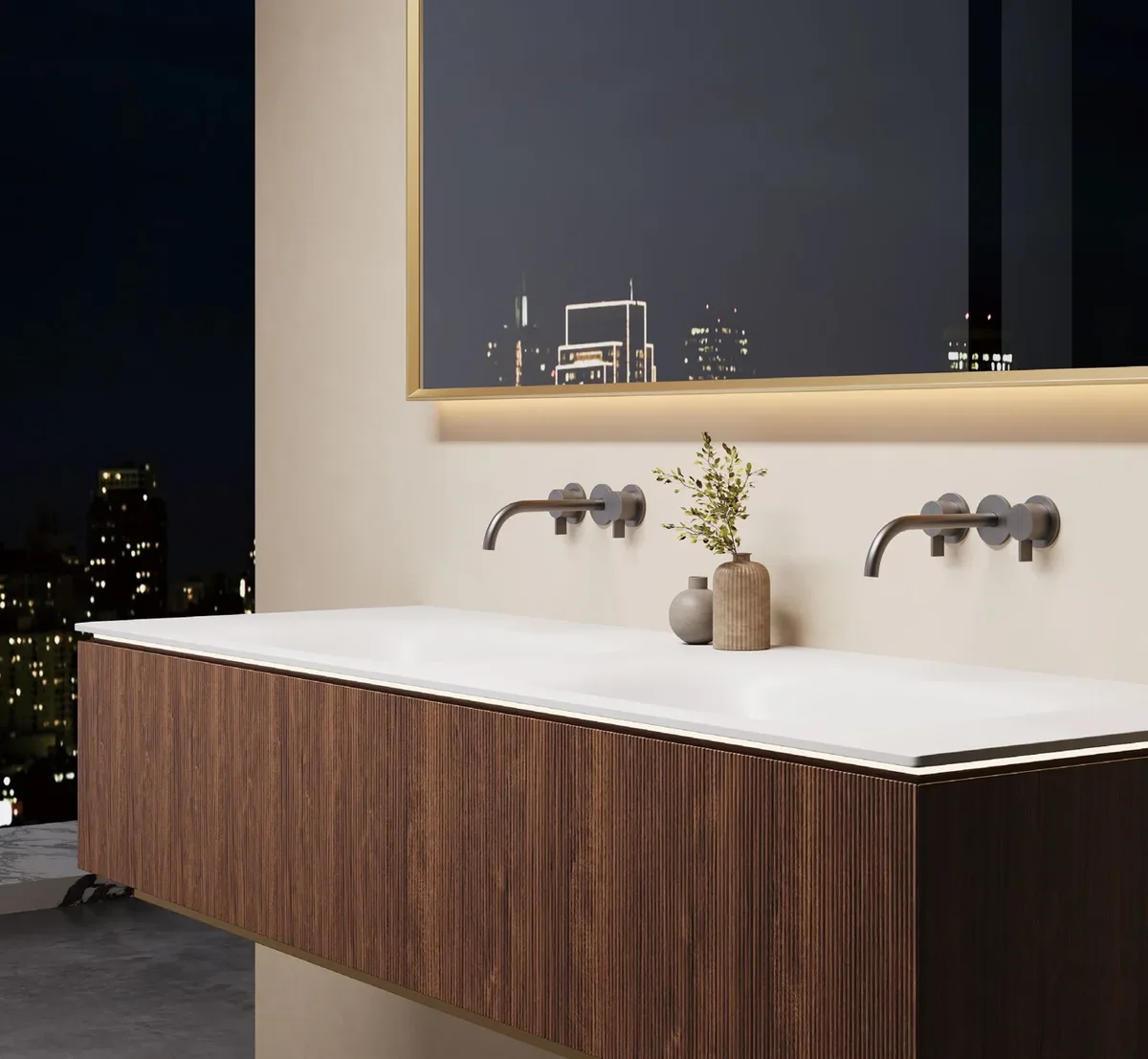
The arrangement in the photograph is the third case: a strip below the glass, washing upward. It lights the jaw and the wall and throws shadow up into the sockets. That suits shaving and flatters skin less, so it is a choice, not a default. Distance matters too: a plane mirror puts the virtual image as far behind the glass as the face is in front of it, so a face 600 mm away is judged at an apparent 1,200 mm, and the light forming it comes from the room side.
- Space either side: two fittings at eye height, diffusers within about 150 mm of the mirror edge.
- No wall space: one fitting above, angled forward rather than straight down.
- Source in the reflected sightline: move it or diffuse it, or the user sees the lamp rather than the face.
Decision rule: draw each fitting on the elevation with a centre height and a distance from the mirror edge in millimetres, and check the position against the reflected sightline before the cable is chased.
04Kelvin, dimming and the two-tone room
Run one colour temperature through one sightline, because 2700 K and 3000 K read warm and domestic, 4000 K reads neutral, and a 4000 K strip in a pool of 3000 K downlights puts a warm cast on one cheek and a cool one on the other.
Two fittings ordered as 3000 K can differ visibly if they come from different production bins, so specify one bin for the zone and ask for the measured value of the delivered batch.
Dimming is a system. The driver must accept the protocol the wall control provides, and a trailing-edge dimmer needs a stated minimum load; many drivers will not run below a certain level and jump from bright to off. Flicker is invisible, and cheap drivers modulate at twice mains frequency, so ask for the driver datasheet.
- Two suppliers, one zone: one bin, or the difference shows in the reflection.
- Dimmer chosen by the electrician: state the protocol and the minimum load the driver needs.
- Flicker not mentioned: ask for the driver datasheet and its modulation depth.
Decision rule: one colour temperature, one bin, one dimming protocol, one driver family, and a written minimum dimming level.
05The mirror is a glass product, and its edge fails first
Protect the edge, because a mirror is a coated glass panel and the coating sits behind the glass where a cut edge exposes it. EN 1036 covers mirrors made from silver-coated float glass for internal use; an aluminium backing reads darker and cooler.
Edge corrosion starts as a dark bloom at a cut edge and spreads inward from the bottom, where water stands and where a demister drives moisture to the cooler rim. A frame hides the edge; a frameless mirror needs a protected edge and a fixing clear of standing water.
IEC 60529 defines the IP code: the first digit covers solids, the second water, so IPX4 resists splashing and IPX5 a jet. The rating applies to the enclosure as tested, not to the gland where the cable enters, and local wiring rules for the zones around a bath or shower decide what a position needs.
Extraction belongs in the brief because steam fogs the glass and feeds the edge. Fans are rated in litres per second or cubic metres per hour: 1 m³/h is about 0.28 l/s, so a 90 m³/h fan is a 25 l/s fan.
- Frameless: protected edge, a fixing clear of standing water, and a bead at the bottom edge.
- Inside a wet zone: the IP rating comes from the local wiring rules, and the gland has to keep it.
- Steam: extract sized at the duct, not the grille, or the edge stays wet.
Decision rule: one line naming the zone, its IP rating, the mirror standard, the edge treatment and the frame, with the extract duty in the same document.
06Integrated light, separate fittings or a lit cabinet
Three arrangements are sold as mirror lighting, and they put light in three places. The choice is a construction decision before a style one: the cable route is fixed when the wall is tiled.
| Arrangement | Where the light lands | What the drawing must show | Failure mode |
|---|---|---|---|
| Mirror with integrated LED | Strip at the glass edge | Cable exit, driver location, access | Driver sealed behind the glass |
| Two wall lights beside the glass | The face, from both sides | Centre height, distance from edge | Set too high; wall lit, face dark |
| One overhead bar or downlight | Crown of the head, basin top | Height, tilt, beam angle | Brow and nose shadow |
| Mirror cabinet, internal light | Shelves and contents | Shelf positions, separate face light | Contents lit, face dark |
An integrated fitting and a wall light are not interchangeable on a schedule: one is replaced with the mirror, the other with a screwdriver.
Metal finish belongs in the conversation. Chrome plating, PVD, powder coating and lacquer each return a face-level lamp differently. Under 3000 K a warm metal reads warmer; under 4000 K the same finish can look grey, so approve a sample under the specified colour temperature.
Decision rule: an integrated fitting where the wall is tiled and no cable can be chased; separate wall lights where the light should outlive the mirror; a face-level light as its own line with any mirror cabinet.
07The RFQ, the switching and the check before tiling
Mirror lighting is decided before tiling and checked after commissioning. Both moments need one page: a plane, a colour target, a position, a rating and a switching arrangement.
- State the measurement plane: vertical lux at a named height, with the mirror light alone and with the room lights on.
- State the colour target: method, Ra, R9 and one colour temperature for the zone, with the bin.
- Dimension each fitting on the elevation: centre height, distance from the mirror edge, direction of tilt.
- State the IP rating for the zone and the cable-entry detail that the rating assumes.
- State the mirror: standard, edge treatment, frame detail and the height of the bottom edge above the basin.
- State the switching, the dimmer's minimum level, and the extract duty with its duct route.
The check takes ten minutes: stand at the drawing's height, look at the shadow under the brow and beside the nose, photograph the face with the lights off and on, run the dimmer to its floor, then look along the bottom edge with a torch.
What your RFQ should state
- The measurement plane: vertical illuminance in lux at a stated height above finished floor, on the plane of the face.
- The colour target: CIE 13.3 method, Ra threshold, R9 reported separately, one colour temperature for the zone.
- The bin and the measured batch value, not the nominal colour temperature on the catalogue page.
- The fitting position as a dimension on the elevation: centre height, distance from the mirror edge, and any tilt.
- The IP rating for the zone to IEC 60529, with the cable gland and entry detail named in the rating.
- The mirror standard (EN 1036), edge treatment, frame detail, and the height of the bottom edge above the basin.
- The switching: number of switches, dimmer type, minimum dimming level and whether the circuit joins a scene.
- The extract duty in l/s or m³/h, the duct route and the door undercut, recorded on the same drawing.
Where this guidance stops
- This article describes how light behaves at a mirror, not specific products. Two fittings with the same Ra can differ in spectrum, flicker and beam.
- The 300–500 lux band is a planning reference for grooming, not a code figure; a designer's target, a hotel standard or a local regulation replaces it.
- A photograph cannot show flicker, the colour temperature bin, the R9 value or edge corrosion. Those need a driver datasheet, a measured report and a retained sample.
- An IP rating covers the enclosure as tested, not the installation; zones and cable routes are the electrical designer's responsibility under the destination's rules.
- Foshan Supply coordinates sourcing, sampling and inspection. We do not test luminaires, issue photometric or colour reports, certify a product, install lighting, or offer a universal warranty.
Questions buyers ask
How many lux should bathroom mirror lighting provide?
The figure that matters is vertical illuminance at the face, not lux on the floor. A designer's target governs where one exists; otherwise treat 300–500 lux on a vertical plane at face height as a planning reference for grooming. State the height and the switching condition, because one fitting reads differently at the chin and at the forehead.
What CRI should I specify for a mirror light?
Specify the method as well as the number. Ra 90 or above to CIE 13.3, with R9 reported separately and not below 50, is a common buying threshold for a fitting at face height. It is a commercial choice rather than a legal minimum. Ask for the colour temperature at which the figure was measured, since values from different colour temperatures are not comparable.
Should mirror lights go above or beside the mirror?
Beside, at eye height, on both sides, if the drawing allows it. That arrangement cross-lights the face and removes the nose and brow shadow a single overhead source creates. A fitting above the glass works if it is angled forward rather than straight down. A strip below the glass suits shaving and flatters skin less.
What colour temperature is right for a bathroom mirror?
2700 K to 3000 K reads warm and domestic, and 4000 K reads neutral and is easier to judge colour under. The more important rule is not to mix them within one sightline: a mirror zone should run on one colour temperature from one bin, or the face picks up two casts at once.
What IP rating does a bathroom mirror light need?
It depends on the zone the fitting occupies, and the zones are set by the destination's wiring rules rather than by the fitting. As a starting point, IPX4 protects against splashing and IPX5 against a jet to IEC 60529. The rating applies to the tested enclosure, so check the cable gland too: a housing drilled on site is no longer that product.
Can a mirror light be fitted inside a shower?
Only where the wiring rules for that zone permit it, the enclosure rating matches the exposure, and the cable entry is sealed to the same standard. Steam and direct spray are different conditions from splash at a basin, and a fitting rated for one is not automatically rated for the other. Have the electrical designer confirm the position before tiling.
Why does a mirror go dark at the edges?
That is edge corrosion. The reflective coating sits behind the glass and is exposed at a cut edge, so water and air attack it from the rim inward, usually from the bottom where water stands. A protected edge, a frame or a continuous bead, and a gap above the basin slow it. Extraction matters too, because a humid room keeps the edge wet.
Sources
- ISO/CIE 8995-1 — Light and lighting: lighting of work places — British Standards Institution
- IEC 60529:1989+AMD1:1999+AMD2:2013 — Degrees of protection provided by enclosures (IP code) — International Electrotechnical Commission
- CIE 13.3 — Method of measuring and specifying colour rendering properties of light sources — International Commission on Illumination
- Glass for Europe — flat glass for building and interior applications, including mirrors from silver-coated float glass — Glass for Europe
- Solid-state lighting: colour quality, flicker and lifetime reporting — US Department of Energy
- Glass and Glazing Federation — technical guidance on mirror and interior glass — Glass and Glazing Federation
Pages related to this guide
How this guide was checked
- Written from the public catalogue, the standards and regulator pages listed under Sources, and the process records described on the services page.
- Catalogue references and model details were checked on 2026-11-05; 6 primary sources are linked above.
- No supplier paid for placement. No price on this page is an offer; ranges are planning references and must be confirmed in a quotation.
How these guides are researched and reviewed · Corrections policy