
In short
- The V1 to V4 label is a supplier declaration for one batch, not a class in ISO 13006, and it does not bind the next delivery.
- Colour, size sort and pattern repeat move independently, so batch code, calibre and face count belong on the purchase order, not only on the carton.
- Order a reserve from the same batch. A 42 m² floor in 600 × 1200 mm tiles takes 58 tiles before cuts, and a later firing will not match them.
Tile shade variation is the difference in colour, tone, pattern and surface between tiles that carry the same product code; the V1 to V4 label is the supplier's shorthand for how much of it to expect. ISO 13006 and EN 14411 do not settle that question: they classify tiles by water absorption, from BIa at 0.5% or less to BIII above 10%, and shade sits outside that classification.
The gap shows at order stage. The first delivery matches the approved sample; the second, ordered for another floor or a repair, comes from another firing, and the difference is visible before the grout is dry. The decision is how much variation you accept.
01The V label describes a batch, not a product range
A tile sold as V1 is described as uniform, V2 as slight, V3 as moderate and V4 as random, and the seller chooses those words. ISO 13006 and EN 14411 classify by water absorption instead: BIa at 0.5% or less, BIb from 0.5% to 3%, BIIa from 3% to 6%, BIIb from 6% to 10%, BIII above 10%. Shade is not a class.
| Declaration | What usually arrives | Typical placement | What it demands |
|---|---|---|---|
| V1 — uniform | Close tonal match; a difference is hard to see unless tiles are held together | Large fields, small rooms, repairs | A batch code and a reserve |
| V2 — slight | A light tonal drift across a box | Wall and floor fields | Blending across boxes during laying |
| V3 — moderate | Visible tonal and pattern movement; an unblended box looks uneven | Feature walls, large living areas | Approved layout, wider reserve, briefed tiler |
| V4 — random | Strong contrast; the field reads as patchwork unless planned | Feature surfaces and exteriors | Drawn layout and a reserve for a whole panel |
Two factories can use V2 for different amounts of movement, so the retained sample does more work than the letter.
Read the label as a risk band, not a promise. A V1 tile from two firings can still show at a doorway; a V4 tile blended across a room can look deliberate.
02Colour, size sort and pattern repeat move independently
Buyers ask one question about shade and get an answer about colour. Three variables are bundled into it, and each one fails differently.
| Variable | What changes | What to ask for | If it is missed |
|---|---|---|---|
| Colour (batch) | Tone shifts between firings | Batch code on carton and delivery note | A visible break between deliveries |
| Size sort (calibre) | Fired size groups in one nominal format | Calibre on the box, and whether rectified | Joints that run tight then wide |
| Pattern (faces) | Which face repeats, and how often | Face count and a repeat diagram | A motif in a column, a diagonal seam |
| Surface (finish) | Polish, matt or relief on one body | Finish name per code, plus a physical sample | A patch that catches light differently |
Colour and calibre are production facts; faces and finish are design facts.
The size sort is the one most often left out. Two tiles can share a 600 × 1200 mm label and sit in different fired-size groups, and mixing them gives a joint that closes and opens across the floor. Rectified tiles are cut to a calibrated size after firing, which allows a joint of about 2–3 mm; a non-rectified tile needs a wider joint because the fired size moves.
Faces carry a maintenance consequence: many faces at random hide a repair, while a sequence produces a visible repeat.
Catalogue reference: tiles and porcelain by format and finish — models, dimensions and finishes for the directions discussed above.
03Shade is set at the kiln and found at the second delivery
The failure that surprises buyers is a good first delivery and a second one that does not match it.
A later run is a separate event even when the recipe is unchanged. The factory sorts its output afterwards, and the group it calls V2 can sit at the edge of your sample. Nothing is defective; the tiles are from another firing. The question for the supplier is what changed between the runs.
The delivery sequence widens the gap. The first container goes to the main rooms; the second arrives weeks later, often for another floor, where the join falls at a doorway and the light changes. That doorway is where the mismatch is photographed.
A second failure waits in the reserve: the margin goes on cuts, and a repair two years later has no matching tile.
04Work out the reserve before you commit to a shade
A reserve is a number of tiles, and it can be calculated before the colour is chosen. The example is a 42 m² floor in 600 × 1200 mm tiles with a 3 mm joint.
- Fix the net area from the drawing: 42 m² of finished floor.
- Convert one tile to a module: 600 × 1200 mm is 0.72 m²; with a 3 mm joint it is 603 × 1203 mm, or 0.7254 m².
- Divide: 42 ÷ 0.7254 = 57.9, so 58 tiles cover the field before cutting.
- Read the cutting plan: a diagonal layout or a border consumes tiles that offcuts cannot replace.
- Decide the reserve in whole tiles: six tiles is 4.4 m² of matching stock.
- Round up to the box quantity, and put the total, the batch and the reserve on the order.
A 10% margin is a habit, not a calculation: a straight lay wastes less, a 45-degree layout wastes more. What matters is the reserve in tiles from the approved batch, because that is what a repair needs.
Tiles kept flat, dry and labelled in the original carton can be matched years later; loose tiles in a garage have lost the evidence.
05Joints and lippage decide how much variation you see
The same tile can look consistent in one room and patchy in another because of the joint.
A rectified tile allows a joint of about 2–3 mm. A non-rectified tile needs a wider joint because its fired size varies; closing the joint to tighten the floor removes the tolerance and produces lippage instead. Lippage is read against a straightedge, with a 1 mm step the usual acceptance threshold for rectified porcelain, tighter on a polished face.
Put the numbers together. A 1 mm step against a 2 mm joint is half the joint width, which reads as a hard line across the floor. Under raking light that line competes with the shade, and a V2 floor starts to look like a V3 one.
The substrate sets the limit. Large formats generally need a C2TE-class adhesive to EN 12004, coverage of at least 90–95%, and a substrate flat to about 3 mm over 2 m. Adhesive in dabs shows at the joint before any colour difference does.
06Slip, frost and absorption are separate lines on the data sheet
A shade conversation can crowd out the specifications that decide whether a floor is safe. Keep them separate, and ask for the report that names the body and finish being supplied.
| Report | What it establishes | When it matters |
|---|---|---|
| ASTM C373 with the ISO 13006 group | Water absorption, and the class from BIa to BIII | Every order |
| ASTM C648 | Breaking strength | Floors, large formats and thin bodies |
| ASTM C1026 | Freeze–thaw resistance | Exterior use and unheated spaces |
| ANSI A326.3 | Wet friction on a level floor | Interior floors; 0.42 is the common reference, not ramps or pool decks |
| DIN 51130, R9 to R13 | Slip class on an oiled ramp | Commercial kitchens, as one input |
| DIN 51097, A to C | Barefoot wet slip class | Pool surrounds and showers |
A report covers a body, a thickness and a finish; ask for the page that names your product.
An R rating is a ramp result, not a complete slip assessment: a tile can be adequate in a dry corridor and marginal at a wet threshold, and DIN 51097 A, B and C exists because barefoot wet areas ask a different question. Frost resistance is a test, not a phrase: without an ASTM C1026 report for the body supplied, frost-proof is an assertion.
Note the finish. A polished and a matt tile from one range can appear in different reports, and the batch code does not say which applies.
07Put the batch, the size sort and the reserve into the RFQ
The specification has one job: turn the batch into a contract term. This sequence takes one exchange with each supplier.
- Name the product code, size, finish and V declaration in the first line of the quote.
- Require one batch, with the batch code and calibre printed on every carton and on the delivery note.
- Ask for the number of faces and a repeat diagram, and approve a layout for feature rooms.
- State the reserve in tiles, from the same batch, packed and labelled separately.
- Name the adhesive class, coverage and substrate flatness the installer will accept.
- Require absorption, strength and, where relevant, freeze–thaw and slip reports naming the finish.
- Agree who inspects a later delivery, against which sample, and what the remedy is.
None of these clauses needs new testing at quotation stage, which is what makes a refusal informative. A supplier who can quote a batch code, a calibre and a face count is describing a product; one who quotes only a look is describing a photograph.
What your RFQ should state
- Product code, nominal size, finish and the declared shade variation, written as V1 to V4 in the first line.
- One production batch for the whole order, with the batch code printed on each carton and on the delivery note.
- The size sort (calibre) and whether the tile is rectified, since both decide the joint width.
- The number of pattern faces, a repeat diagram and an approved layout for feature areas.
- A reserve in whole tiles, drawn from the same batch, packed and labelled separately.
- The adhesive class to EN 12004, the coverage percentage and the substrate flatness the installer will accept.
- The ASTM C373, C648 and, where relevant, C1026 reports for the supplied body and finish.
- The procedure and the remedy if a later delivery fails to match the retained approved sample.
Where this guidance stops
- This article explains how variation is declared and controlled; it does not decide which shade suits a room, which needs a physical sample in the project's own light.
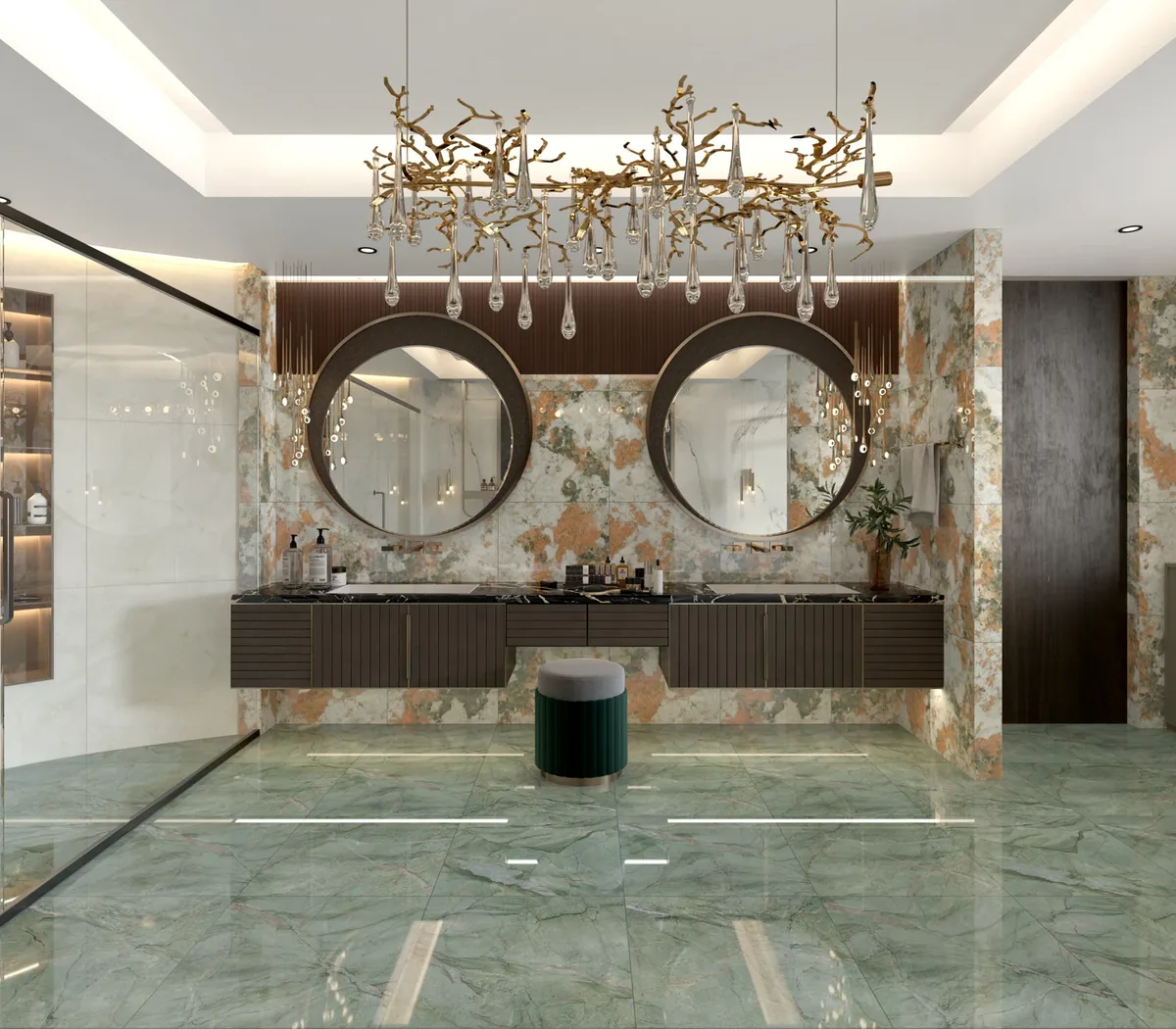
- A photograph, including the one above, cannot show a batch difference. Two tiles that look identical on screen can differ on the same wall.
- The V1 to V4 scale is a supplier declaration, and two factories can use the same letter for different amounts of movement.
- Slip, frost and absorption results depend on the body, the finish and the installation, and a report only covers what it names.
- Foshan Supply coordinates sourcing, sampling and inspection. We do not manufacture tiles, issue test reports or certificates, or offer a universal warranty; the supplier's data and the agreed inspection scope govern.
Questions buyers ask
What does V1 to V4 mean on a tile sample?
It is a supplier's declaration of how much colour and pattern movement to expect within a batch: V1 uniform, V2 slight, V3 moderate, V4 random. The scale is not part of ISO 13006 or EN 14411 and does not promise that the next delivery will match. Treat it as a guide to how much blending the installation needs, then confirm the batch code.
Is shade variation covered by ISO 13006 or EN 14411?
No. Those standards classify ceramic tiles by water absorption, from BIa at 0.5% or less through BIb, BIIa and BIIb to BIII above 10%, and by other technical properties. The V1 to V4 scale sits outside that classification. A data sheet citing a group describes the body, not how closely two deliveries match each other.
Can I mix two batches in one room?
You can, but the join will show. Two firings of the same code can differ in tone, most visibly where light changes, such as a doorway or a window reveal. If a room must take two batches, blend boxes across the whole field and put the join where furniture hides it. Better still, buy the room from one batch.
How many spare tiles should I keep?
Count the reserve in tiles, not percentages. On a 42 m² floor in 600 × 1200 mm tiles, six tiles is 4.4 m² of matching stock, enough for a later repair. Keep them from the approved batch, in the original carton with the batch code visible. A reserve bought later is a different colour.
Why do my tiles look darker than the showroom sample?
Showroom lighting, wall colour and sample size change how a tile reads, and a chip on a white board is not a floor. Compare a full carton in the room, in daylight and under evening lighting, before fixing. If the difference survives, check the batch code against the approved sample.
Do rectified tiles have less shade variation?
No. Rectification corrects the fired size, not the colour. A rectified tile is cut back to a calibrated size after firing, which allows a joint of about 2–3 mm and reduces size variation. Colour still comes from the body and glaze of that firing, so a rectified tile from a second batch can be a different tone.
What should I do if the second delivery is a different shade?
Stop laying and compare the delivery against the signed, dated sample from the first batch. Photograph both in the same light and check the carton batch codes. If the batch differs, ask for stock from the approved batch before accepting a remedy: once tiles are fixed, a supply question becomes a removal cost.
Sources
- ISO 13006:2018 — Ceramic tiles: definitions, classification, characteristics and marking — International Organization for Standardization
- ANSI A326.3 — Test method for measuring dynamic coefficient of friction of hard surface flooring — Tile Council of North America
- ASTM C648 — Standard test method for breaking strength of ceramic tile — ASTM International
- ASTM C373 — Standard test methods for determination of water absorption and bulk specific gravity of ceramic tile — ASTM International
- EN 12004 — Adhesives for tiles: definitions and specifications — European Committee for Standardization
- ASTM C1026 — Standard test method for measuring the resistance of ceramic tile to freeze-thaw cycling — ASTM International
Pages related to this guide
How this guide was checked
- Written from the public catalogue, the standards and regulator pages listed under Sources, and the process records described on the services page.
- Catalogue references and model details were checked on 2026-11-05; 6 primary sources are linked above.
- No supplier paid for placement. No price on this page is an offer; ranges are planning references and must be confirmed in a quotation.
How these guides are researched and reviewed · Corrections policy